
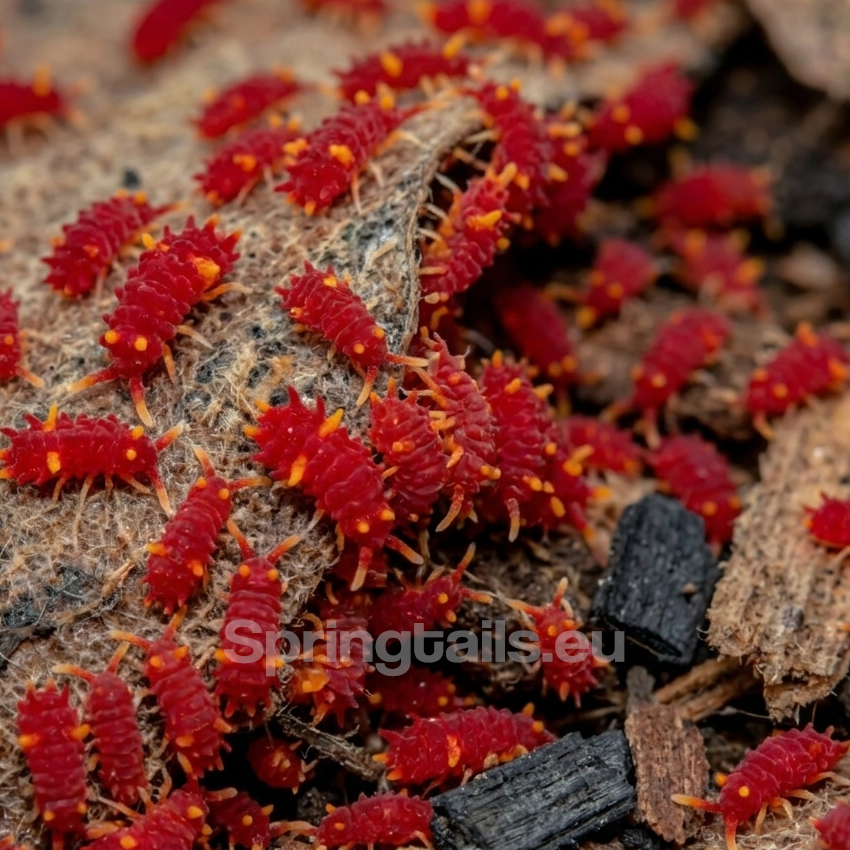
Lobellini sp. “Pennywise”
Rare slime mold-feeding springtail highly prized by collectors. An unusual and fascinating species with distinctive appearance and specialized ecological behavior. The large dorsal spines give Lobellini sp. “Pennywise” a unique dragon-like appearance rarely seen in other springtail species.
⚠️ Live animals ⚠️
Express shipping includes full DOA guarantee.
Standard shipping includes replacement only.
- Preparation time: 1-5 days
- Clean products: Our farms are free of other insects
- Free Shipping: On all orders over 300€
Lobellini sp. “Pennywise” – Rare Slime Mold Feeding Springtails
Lobellini Pennywise is one of the most unusual and sought-after springtail species currently available in the hobby. Famous for its chunky body shape, distinctive appearance, and specialized feeding behavior, this species has quickly become a favorite among advanced springtail keepers and microfauna collectors.
Unlike typical springtails that readily consume yeast and decomposing organic matter, Pennywise belongs to a group of springtails associated with slime molds and biofilms. This makes them a fascinating species for enthusiasts interested in observing unique ecological behaviors.
Lobellini Pennywise for Advanced Collections
This species is primarily recommended for experienced keepers. Its unusual appearance and specialized requirements make it more suitable for dedicated cultures than standard bioactive clean-up crew applications.
Lobellini sp. “Pennywise” is one of the most visually striking springtails in the hobby. Its intense crimson-red coloration is combined with prominent conical dorsal spines and enlarged tubercles, creating a highly textured, almost armored appearance. Bright yellow antennae and appendages provide a dramatic contrast that makes this species instantly recognizable.
Pennywise Springtails Characteristics
- Origin: Vietnam
- Adult size: 0.4 cm
- Rare and highly collectible species
- Bright crimson-red body
- Prominent dorsal spines and tubercles
- Contrasting yellow antennae and appendages
- Associated with slime mold feeding behavior
- Active and highly visible compared to many micro springtails
- Excellent rare tropical display species for collectors
Slime Mold Feeding Springtails Care Guide
- Temperature: 20–28°C
- Humidity: High and stable
- Substrate: Moist soil, leaf litter, moss, and decomposing organic material
- Food: Slime molds, biofilms, and naturally developing microflora
Unique Feeding Behaviour
One of the most remarkable features of Lobellini sp. “Pennywise” is its strong association with slime molds. Many keepers maintain cultures specifically designed to encourage natural slime mold growth.
Because of this specialization, these springtails are often considered a collector species rather than a beginner springtail culture.
Establishing a Healthy Colony
Stable humidity and minimal disturbance are important for long-term success. Cultures usually perform best when allowed to develop a rich microbial ecosystem with mosses, leaf litter, and naturally occurring biofilms.
Additionally, maintaining a mature culture environment often produces better results than sterile setups.
Why Choose Lobellini sp. “Pennywise”?
Lobellini sp. “Pennywise” is perfect for hobbyists looking for something truly different. Its unusual appearance, rarity, and specialized feeding behavior make it one of the most interesting springtail species available today.
Whether you are a serious springtail collector or a microfauna enthusiast, this species offers a unique experience rarely found in conventional cultures.
Discover more rare species in our Springtails Collection.
Learn more about springtails on Wikipedia.
Image credits: @Colembolab
Be the first to review “Lobellini sp. “Pennywise””
You must be logged in to post a review.
Related products
-
Sinella curviseta
Price range: 4,99 € through 89,99 € -
Porcellio laevis “Orange”
Price range: 14,99 € through 29,99 € -
Coecobrya sp. “Tropical White”
Price range: 4,99 € through 89,99 € -
Onychiuridae sp. “Snowflakes”
Price range: 4,99 € through 79,99 € -
Trichorhina tomentosa
Price range: 9,99 € through 49,99 €
Reviews
There are no reviews yet.